Why Falling in Love Changes How Clearly You Think
Romantic love can temporarily affect judgment, risk perception, and decision-making more than most people realize.
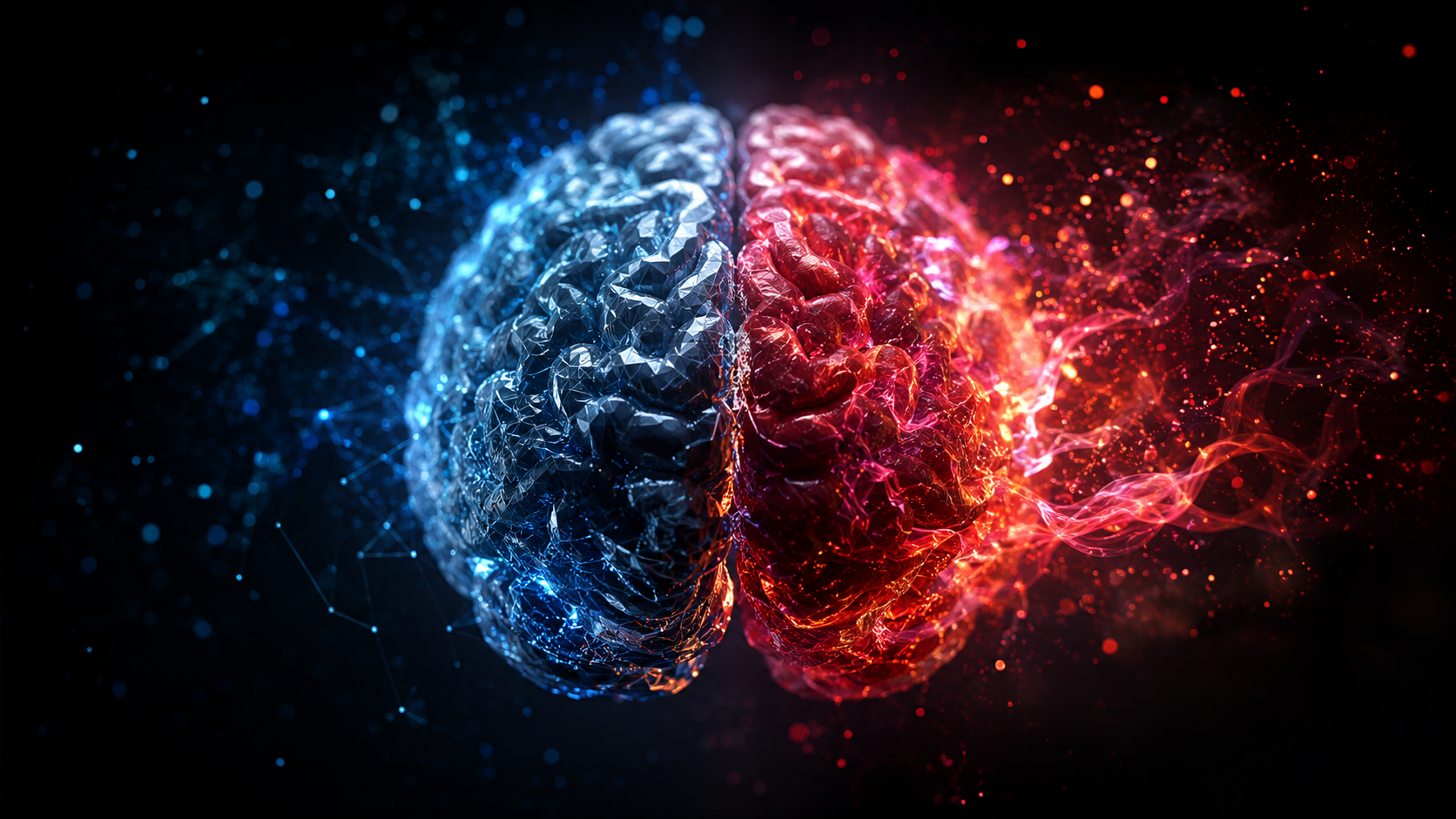
Key idea
Falling in love does not make you less intelligent. It changes what your brain prioritizes.
There is scientific evidence showing that falling in love can temporarily alter some of the brain’s most important cognitive functions.
Activity in regions associated with critical judgment can change.
Risk perception can decrease.
And the reward system can activate in ways similar to those observed in certain addictive processes.
And somehow, everyone still wants to fall in love.
There is no contradiction there.
There is a biological system operating exactly the way it evolved to operate.
The problem is that almost nobody explains it clearly.
Not to destroy romantic love.
But to understand it with enough precision to make more conscious decisions inside of it.
The complete system in three phases
Romantic love is not one single emotion.
It is a system.
And during intense infatuation, that system can temporarily change how you evaluate another person.
Phase 1 — Attraction: dopamine and anticipation
Dopamine is often described as the neurotransmitter of pleasure.
But that definition is incomplete.
Dopamine is much more connected to the anticipation of pleasure than to pleasure itself.
When someone attracts you, your reward system releases dopamine not only because of the interaction happening now, but because of the possibility of what could happen next.
Neuroimaging studies conducted by Helen Fisher and her collaborators showed activation in reward-related regions such as the ventral tegmental area and the caudate nucleus in people who were intensely in love.
These are part of the brain’s reward and motivation systems.
And they overlap with circuits involved in certain addictive processes.
Not as a metaphor.
As a description of the neurological mechanism.
And like other dopamine-based systems, the initial intensity tends to decrease over time.
The same source of stimulation gradually stops producing the same emotional response.
That is why the beginning of romantic infatuation can feel so overwhelming.
Every message feels important.
Every call feels meaningful.
Every interaction feels loaded with significance.
Your brain is not broken.
It just has different priorities.
Phase 2 — Bonding: oxytocin and the amygdala
As emotional attachment deepens, oxytocin starts playing a more central role.
Often called the “love hormone” or the “bonding hormone,” oxytocin is involved in trust, emotional closeness, and attachment formation.
But there is another side to it that gets mentioned far less often.
In certain contexts, oxytocin can influence the way the amygdala responds.
The amygdala is a brain structure associated with threat detection, risk evaluation, and emotional processing of potentially negative signals.
In simpler terms, it is part of the brain’s internal alarm system.
When that response becomes temporarily reduced, certain warning signs can feel emotionally less intense.
They do not disappear.
But they may stop feeling as important.
The evolutionary logic behind this mechanism is relatively clear.
If the brain evaluated every possible social threat at maximum intensity during courtship, forming deep emotional bonds would become much more difficult.
Partially lowering that vigilance helps attachment happen.
The practical consequence is that during intense infatuation, the brain can become temporarily less critical when evaluating the person creating that emotional state.
Phase 3 — Obsession: serotonin and the prefrontal cortex
Another important part of romantic infatuation involves obsessive attention.
Some research has found serotonin patterns in people experiencing intense romantic love that resemble patterns observed in obsessive-compulsive disorder.
Not as an insult.
As a mechanism.
Low or altered serotonin activity has been associated with intrusive and repetitive thoughts.
That helps explain why it can become so difficult to stop thinking about someone during the early stages of romantic attachment.
It is not only romanticism.
It is also neurochemistry.
A second important pattern involves the prefrontal cortex.
Research by Andreas Bartels and other neuroimaging studies on romantic love have shown changes in brain regions associated with social judgment, critical evaluation, and rational assessment.
The prefrontal cortex is one of the brain regions most associated with what we casually describe as “thinking clearly.”
And during intense infatuation, it can operate differently from its normal baseline state.
The combination of elevated dopamine, altered serotonin, changes in emotional processing, and modified prefrontal activity produces a very specific condition:
a period where forming the bond becomes the biological priority, even if part of your critical clarity temporarily decreases.
The duration — and what comes after
After more than three decades studying romantic love across different cultures, Helen Fisher estimated that the intense phase of romantic infatuation usually lasts between 12 and 18 months on average in relatively stable relationships.
In situations involving uncertainty, distance, or unpredictable rewards, the dopamine system can remain active for longer and extend that intensity.
Over time, the brain slowly starts returning to baseline.
Prefrontal activity stabilizes.
Risk perception regains intensity.
Serotonin levels regulate.
And many people experience something strange:
they begin seeing the other person differently.
Not necessarily because the person changed.
But because the brain is now processing the relationship with less neurochemical interference.
This period often coincides with one of the stages of highest tension in many relationships.
Not always because love disappears.
Sometimes because infatuation stops covering what was already there from the beginning.
Relationships built on genuine compatibility underneath the initial intensity tend to move through this transition more smoothly.
Relationships sustained mostly by neurochemical intensity often experience it as loss.
Web exclusive — unrequited love
There is one part of the system that requires more space to explain properly.
The brain does not perfectly distinguish between reciprocated and unreciprocated love.
Many of the mechanisms described above can activate in both situations.
The difference appears inside the reward system.
In unrequited love, the anticipated reward never fully arrives.
And that can create a cycle of prolonged anticipation without resolution.
Addiction research has shown that intermittent and unpredictable rewards can produce especially powerful dopamine responses.
Gambling systems work on this exact principle.
Uncertainty keeps the anticipation circuit active.
Applied to unrequited love, this helps explain why it can sometimes feel even more intense than a stable, reciprocated relationship.
Not more fulfilling.
Not healthier.
But more intense.
Your brain keeps waiting for a resolution that never fully comes.
And as long as possibility still exists, the system can continue feeding itself.
Make it real
Try this to question what you assume
- 1When emotions are intense, avoid making permanent decisions too quickly.
- 2Pay attention to repeated patterns, not isolated moments.
- 3Ask whether you are seeing compatibility or only intensity.
- 4Give your brain enough time to process the relationship outside the peak emotional state.
Quick Questions
Does falling in love really make you dumber?
Not literally. It does not reduce your intelligence. But it can temporarily change how your brain prioritizes judgment, risk, attention, and emotional bonding.
Why do red flags feel less important when you are in love?
Because systems involved in attachment and emotional processing can temporarily reduce the intensity of threat evaluation. The red flags may still be visible, but they may not feel as urgent.
How long does intense romantic infatuation usually last?
Helen Fisher estimated that the most intense phase often lasts around 12 to 18 months on average in relatively stable relationships, although uncertainty or distance can extend the intensity.
The final question
Does understanding the system behind what we feel change anything?
Maybe it does not destroy love.
Maybe it simply makes it more honest.
If you want to keep exploring the invisible systems behind the mind, behavior, and the way we interpret the world, you can keep reading on AtomicCurious.
And if you want to receive future explorations before everyone else, you can join the newsletter.
AtomicCurious — Exploring science, technology & smart curiosities.
Watch video
Video
Keep exploring
More from Curiosity · Atom
More posts in this format — then jump across routes whenever you want.
Why We Work 8 Hours a Day
The real origin of the 8-hour workday and why it was never designed for the kind of work you do today.
AI Understands Nothing… So Why Is It Already Making Decisions for You?
AI systems do not think like humans, yet they already influence work, information and everyday decisions.
Why Does Music Work Even Without Translation?
Music activates deeply human brain systems even when you do not understand the lyrics.
Why Modern Entertainment Is Designed to Kill Boredom
Modern platforms compete for something deeper than your attention: your ability to feel bored.
AtomicCurious
Now you know where your 8 hours came from
The question is: will you keep using them the same way? If this topic stayed with you, the full video goes deeper. And what doesn’t fit here lives in the newsletter.
Resources
Recommended resources
Book
Why We Love — Helen Fisher
The researcher who helped map the brain in love. A clear look at the neuroscience and chemistry behind romantic attraction.
View on Amazon →
Book
Attached — Amir Levine
How attachment styles shape emotional decisions, bonds, and the way we experience relationships.
View on Amazon →
Book
Emotional Intelligence — Daniel Goleman
Why emotions influence thinking, behavior, and decision-making far more than we usually assume.
View on Amazon →
Some links are affiliate links. We may earn a commission at no extra cost to you.