Why Modern Entertainment Is Designed to Kill Boredom
Modern platforms compete for something deeper than your attention: your ability to feel bored.
Key idea
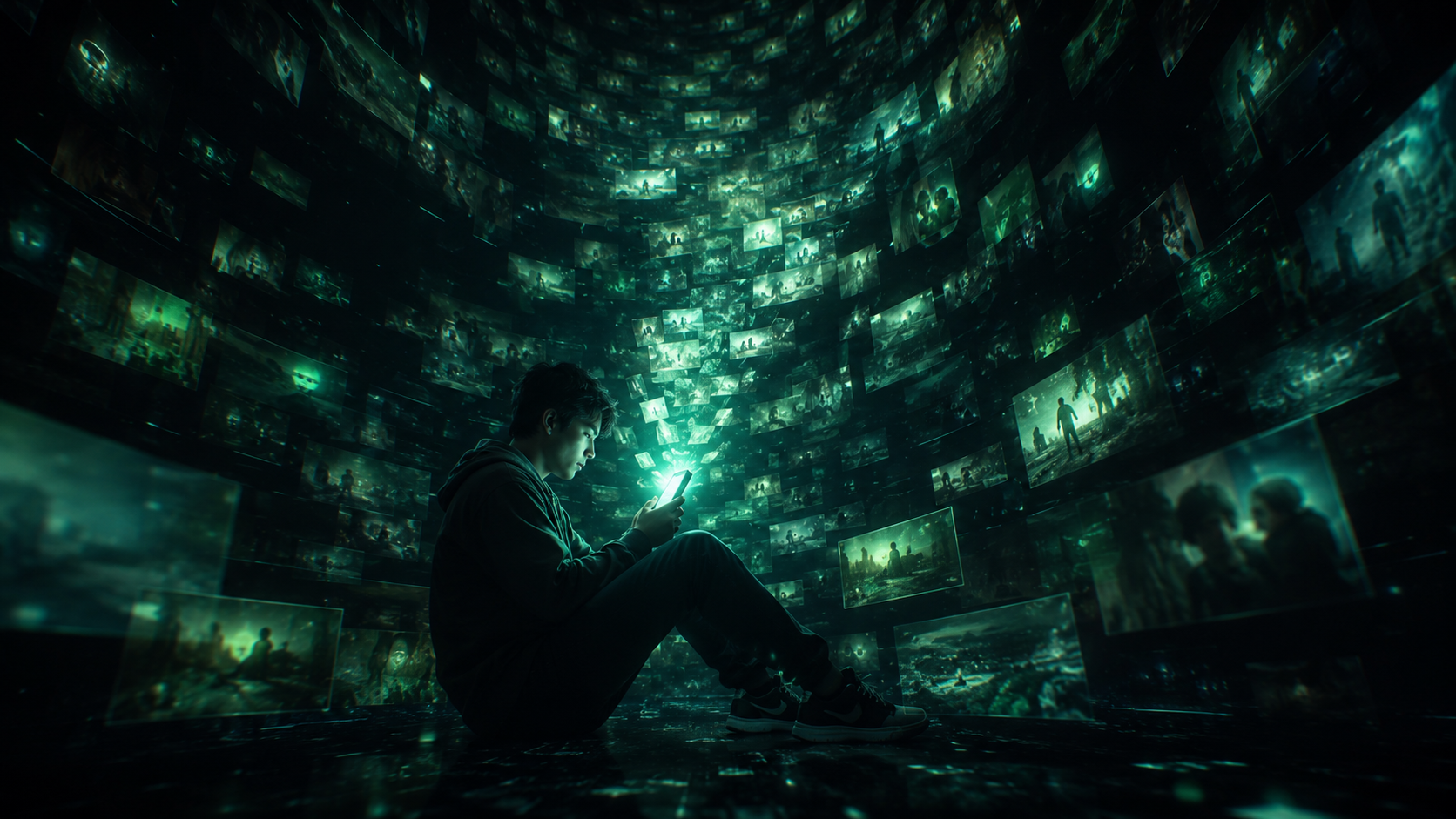
Modern entertainment captures attention not only by making content appealing, but by removing natural stopping points and filling the quiet moments in which people would otherwise choose what to do next.
You open your phone to watch one video.
Not twenty.
Not enough videos to learn the complete history of a stranger’s relationship, reorganise your kitchen, discover three conspiracy theories, and watch someone restore a carpet that looked perfectly fine before they buried it in mud.
Just one video.
A few minutes later, you look at the time.
Something strange has happened.
The original video ended long ago. You do not clearly remember choosing the videos that followed it. You may not even remember most of what you watched.
You did not decide to spend that much time.
You simply never reached a clear moment when continuing required another decision.
That is the important change.
Modern entertainment did not only become faster, more personal, or more available.
It changed where the decision lives.
In older forms of entertainment, you usually had to act to continue.
Now you often have to act to stop.
The next episode begins automatically. The next video is already waiting. The feed produces new content before you reach the bottom. A notification can restart the process after you have already left.
The system does not need to force you to stay.
It only needs to make leaving slightly harder than doing nothing.
The rule of this article
Before going further, we need one rule.
This is not an argument that entertainment is bad.
Watching a film can be meaningful. A video game can demand planning, patience, coordination, and skill. A series can become part of your relationship with other people. A YouTube video can teach you something that changes your career.
This is also not an argument that every screen activity is equal.
Calling a family member is not the same as scrolling through short videos.
Writing is not the same as watching.
Playing a difficult game is not the same as allowing an endless feed to choose the next thirty pieces of content for you.
And this is definitely not an argument that one minute on TikTok destroys your brain.
The evidence does not support claims that simple.
The real question is more specific:
How do autoplay, infinite feeds, notifications, recommendations, and rapidly changing content affect the moment when you decide whether to continue?
That question matters because attention is not controlled only by willpower.
It is also shaped by the environment in which that willpower has to operate.
A person can still choose to leave.
But design can decide how often that person is invited to make the choice.
Entertainment used to contain stopping cues
A stopping cue is simply a signal that an activity has reached a natural pause.
The film ends.
The programme finishes.
You reach the final page.
The magazine has no more articles.
The CD reaches the last track.
These moments do not prevent you from continuing. You can start another film, open another book, or replay the album.
But first, there is a gap.
Inside that gap is a question:
“Do I want more?”
The answer may still be yes.
The important part is that the question appeared.
Traditional television even placed large interruptions between episodes. You waited for the next broadcast, changed the channel, or found something else to do.
This system was not automatically healthier. People could still watch television for hours. Entire weekends disappeared into marathons long before streaming arrived.
But the format contained edges.
Modern platforms discovered that many of those edges were unnecessary.
A user did not need to return to a menu.
A page did not need a bottom.
A video did not need to end in silence.
Every ending could be connected directly to another beginning.
The five-second decision
Consider the countdown that appears when an episode finishes.
You have already watched for twenty, forty, or sixty minutes. You are comfortable. The story has probably ended with an unanswered question. The remote may be on the other side of the room, which is apparently now an international journey.
A timer appears.
Five.
Four.
Three.
If you do nothing, the next episode begins.
This looks like a small convenience.
But it changes the default.
Without autoplay, continuing requires action. You must select another episode and press play.
With autoplay, continuing requires nothing. Stopping is now the action.
The difference is not philosophical. It changes behaviour.
In an experimental study involving 76 Netflix users, researchers divided participants into two groups. One group kept autoplay active. The other disabled it.
Turning autoplay off reduced average session length by approximately 17.6 minutes. Average daily viewing was also lower relative to the group that kept autoplay.
The study does not prove that every viewer will save exactly 17.6 minutes. The sample was limited, people knew their viewing was being studied, and individual habits varied.
But it demonstrates something important:
A feature that appears to remove one small inconvenience can change how long people continue watching.
The participants still had access to the same programmes.
The content did not become less interesting.
The only major difference was that the next episode required a decision.
Infinite scroll removes the bottom
Autoplay connects one ending to another beginning.
Infinite scroll goes further.
It removes the ending completely.
A printed newspaper has a final page. A search engine traditionally separates results into pages. Even a badly organised website eventually runs out of things to show you.
An infinite feed continuously loads more content as you move down.
There is no final post.
There is no empty space.
There is no message saying:
“You have now seen enough opinions from people you have never met.”
The feed can continue for as long as the platform has content to rank.
And the platform does not need to prepare one perfect sequence in advance. It can keep changing the sequence based on how you behave.
A field study of infinite scrolling found that users often described becoming caught in a loop and remaining on social media longer than they intended. People usually stopped because something outside the feed interrupted them: another responsibility, physical discomfort, a change in location, or awareness of the time.
The feed itself rarely provided the reason to leave.
That is the key difference between a large collection and an endless one.
A large collection says:
“There is more if you choose to continue.”
An endless feed says nothing.
It simply continues.
The platform is not only showing content
An infinite feed would be less powerful if the content appeared randomly.
But modern feeds learn from behaviour.
TikTok explains that its For You system ranks videos using signals including what people watch, like, share, search for, comment on, or mark as uninteresting.
YouTube describes recommendations that use viewing behaviour, likes, dislikes, subscriptions, feedback, the current video, and patterns across other viewers.
The exact systems are complex and constantly changing. No single employee writes a personal list for you every morning.
The system makes predictions.
How likely are you to watch?
How long might you stay?
Will you click?
Will you return?
Will this video satisfy you?
Will it make you angry enough to respond?
A platform does not need to understand why a piece of content works.
It only needs evidence that it did.
Perhaps you watched because the video was useful.
Perhaps you watched because it was shocking.
Perhaps you watched because you disagreed with every word and needed to reach the end before informing a stranger that they were wrong.
From the platform’s perspective, all three can look like attention.
The recommendation system then updates its predictions.
You are not simply consuming the feed.
Your behaviour is helping to build the next version of it.
Why the next video is often more powerful than the current one
Most videos in a long scrolling session are not extraordinary.
Some are repetitive.
Some are mildly interesting.
Some begin with:
“Nobody is talking about this.”
Usually, many people are talking about it.
But occasionally, something appears that feels perfect.
It answers a question you had.
It makes you laugh.
It surprises you.
It produces anger, curiosity, recognition, or relief.
You do not know when that moment will arrive.
That uncertainty matters.
In behavioural research, actions can become persistent when rewards arrive unpredictably. The person or animal cannot know which attempt will produce the result, so another attempt remains tempting.
Social media is more complicated than a laboratory reward schedule. A video is not a food pellet, and a person scrolling through Instagram is not simply repeating one identical action for one identical reward.
The content changes.
The motives change.
The rewards can be social, emotional, informative, funny, or personal.
Still, the basic uncertainty remains:
“Maybe the next one will be better.”
Research using large datasets of social media behaviour has found that reward-learning principles help explain how social feedback influences posting. Likes and other forms of feedback can affect how quickly people post again.
That research studied posting behaviour rather than proving that every swipe follows the same mechanism.
But it supports a broader point:
Online behaviour can be shaped by the expectation and timing of rewards, even when the person is not consciously calculating them.
Dopamine is not a magic explanation
Any discussion of scrolling eventually reaches dopamine.
Often within thirty seconds.
Dopamine is then described as a pleasure chemical that platforms inject into your brain every time you swipe.
That explanation is simple.
It is also incomplete.
Dopamine is involved in motivation, learning, movement, attention, and the prediction of rewards. It helps the brain update which actions may be worth repeating.
This does not mean every video produces pleasure.
You can continue scrolling while feeling bored.
You can continue while becoming irritated.
You can continue while repeatedly thinking:
“I should stop.”
The system does not require constant happiness.
It only requires enough expectation, habit, or unfinished curiosity to produce one more action.
That is why reducing the entire problem to dopamine can distract from the visible design.
You do not need a brain scan to notice that the feed has no bottom.
You do not need a chemical explanation to understand that autoplay removes a decision.
The biology matters.
But so does the button.
“I do not even remember what I watched”
Many people recognise a particular kind of scrolling session.
You are awake.
Your eyes are open.
Your finger is moving.
But your sense of time becomes weaker, and very little of the content remains in memory.
Researchers have studied this experience using the idea of normative dissociation.
The word sounds dramatic, but the basic experience is familiar: becoming so absorbed that awareness of yourself, your surroundings, or your original goal temporarily fades.
This is not always harmful.
People can become absorbed in books, music, sport, games, work, or conversation. Losing track of time can be enjoyable and restorative.
The problem is the difference between choosing absorption and slipping into it.
In a 2022 study, researchers gave 43 participants a custom social media application. Participants described moments when scrolling felt like a useful mental break.
They also described sessions in which they passively continued, remembered little, and later felt that their time had been wasted.
Features such as reading-history labels, custom lists, usage information, and time-limit messages reduced this passive state.
The result suggests that the issue is not simply how much content exists.
The design can affect whether people remain aware of what they are doing.
Friction feels annoying because it works
Designers usually try to remove friction.
Fewer clicks.
Faster loading.
Automatic logins.
Saved payment information.
Immediate playback.
In many situations, this is useful. Nobody wants to complete a seventeen-step form to watch a two-minute video.
But friction is not always a defect.
Sometimes friction is the moment that protects a decision.
Researchers have tested tools that create a short pause before opening selected applications. One such intervention asks users to wait briefly and decide whether they still want to enter.
Studies of this approach found that small delays could reduce repeated app openings and make the remaining openings feel more intentional.
Other experiments have added friction inside social feeds. In one study, participants had to interact with each post before more content appeared. They later remembered more of what they had seen than participants using an infinite feed.
They also found the friction frustrating.
That reaction is important.
A feature can support your intentions and still feel less pleasant.
Convenience is immediately noticeable.
Control is often noticeable only after it disappears.
What the forty-seven-second number really means
A widely repeated claim says that the modern human attention span is now forty-seven seconds.
That is not what the research shows.
Gloria Mark and her colleagues studied how people moved between screens and work activities. In more recent observations, people spent an average of roughly forty-seven seconds on a screen before switching.
Earlier studies found longer periods.
This does not mean a human being becomes incapable of concentrating after forty-seven seconds.
People still watch long films, play complex games, read books, write software, and argue online for durations that would impress an endurance athlete.
The number measures switching behaviour in particular digital environments.
It shows how often those environments invite a change of focus.
A message arrives.
A tab remains open.
A notification appears.
A link promises an answer.
The answer contains another link.
Twenty minutes later, you know how a submarine toilet works but have not completed the task you originally opened the browser to do.
Switching can be necessary. Many jobs require communication and several tools.
But each switch creates a small cost. The brain must recover the previous goal, remember what was happening, and rebuild context.
The issue is not that human attention suddenly became forty-seven seconds long.
It is that digital environments became very good at offering an alternative before the current task becomes rewarding.
Short videos do not need to destroy attention to change expectations
Short-form video is often blamed for creating an entire generation incapable of concentrating.
The evidence is not strong enough for a claim that absolute.
Many studies find associations between heavy or problematic short-video use and lower attention control, greater procrastination, or more inattentive behaviour.
But association does not automatically prove cause.
People who already struggle with attention may be more attracted to rapidly changing content. Sleep, stress, age, personality, mental health, and the kind of content being watched can all matter.
Still, experiments give us reasons to take rapid context changes seriously.
In one study, participants watched short videos while switching frequently between pieces of unrelated content. Afterwards, they performed worse on a task that required them to remember and carry out a future intention.
The researchers were not measuring whether TikTok had permanently changed anyone’s brain.
They were measuring an immediate effect.
Rapidly changing contexts made it harder to hold an intention in mind.
That matters because everyday life depends on future intentions:
Reply to the message.
Take the medication.
Return to the assignment.
Turn off the oven.
Remember why you entered the room.
The last one was already difficult before short videos arrived.
Speed changes what normal feels like
A book cannot change its topic, voice, music, visual style, emotional tone, and central conflict every fifteen seconds.
It does not know that it is competing.
It is simply there.
Being a book.
A conversation also contains pauses.
A difficult skill contains repetition.
Work often contains long periods during which nothing exciting happens.
If a person becomes used to highly compressed entertainment, these slower activities may begin to feel unusually empty.
That does not necessarily mean the person has lost the ability to perform them.
It may mean the expected level of stimulation has changed.
A quiet activity now has to compete with a system that can instantly offer novelty, emotion, movement, social feedback, and personal relevance.
The comparison is unfair.
Real life was not designed by a recommendation engine.
A friend telling a story cannot test twelve different openings and keep the one with the highest retention.
A textbook cannot detect that you are losing interest and immediately replace the chapter with a dog wearing sunglasses.
Slower activities often become rewarding later.
The feed specialises in rewarding the next second.
What boredom actually is
Boredom is often described as nothing happening.
But boredom is an active signal.
It appears when you want to engage with something meaningful or satisfying and the current situation fails to provide it.
That failure can happen for several reasons.
The activity may be too easy.
Too difficult.
Too repetitive.
Meaningless.
Impossible to control.
Or simply no longer relevant.
Boredom can be uncomfortable because it pushes you to change something.
That change might be useful.
You leave an unhelpful activity.
You explore.
You create.
You reflect.
You rest.
Or you finally complete the task you have been avoiding since last Thursday.
The change can also be harmful. Bored people can become impulsive, take risks, or choose any stimulation available.
Boredom is not automatically wise.
It is information.
The question is what you do with it.
Does boredom make people creative?
Some experiments suggest that boredom can support certain kinds of creativity.
In studies by Sandi Mann and Rebekah Cadman, participants completed repetitive tasks before attempting creative exercises. Some of the bored groups produced more ideas or more original responses than control groups.
One possible explanation is mind-wandering.
When attention is not fully occupied by the external task, thought can move towards memories, imagined futures, personal concerns, and loose associations.
That can help ideas connect.
But the research does not prove that every boring experience increases creativity.
Reviews of the field describe a more complicated relationship. Boredom can encourage exploration, but it can also reduce motivation and performance. The result depends on the person, the task, and whether there is a meaningful alternative available.
Three hours staring at a wall will not guarantee a business idea.
You would probably last until Tuesday.
The useful conclusion is smaller:
Your mind does not need every quiet second to be filled.
Some unstructured time may allow thoughts to develop that constant input interrupts.
Every pause became available inventory
Waiting used to contain unavoidable emptiness.
Waiting for a bus.
Standing in a queue.
Sitting in a car before entering a building.
Walking to a nearby shop.
Lying in bed before sleep.
Eating alone.
These moments were not always profound. People did not spend every bus journey solving philosophy.
Sometimes they stared at an advertisement.
Sometimes they counted ceiling tiles.
Sometimes they did absolutely nothing useful.
But the moments belonged to them.
Today, nearly every transition can be filled.
This creates a new kind of competition.
Platforms are not competing only with other platforms.
They are competing with silence.
With thought.
With sleep.
With the few minutes between activities.
A company does not need to declare war on boredom for this to happen.
It only needs to see every unused moment as an opportunity for engagement.
From the perspective of the platform, the elevator is an empty session.
The queue is an unopened app.
The moment before sleep is available viewing time.
From the perspective of a person, those same moments may be where the day is processed.
Why the business model matters
Not every platform earns money in the same way.
Some depend heavily on advertising.
Some depend on subscriptions.
Some sell products, memberships, digital goods, or access to additional features.
Many combine several models.
This is why the phrase “you are the product” is sometimes useful but often too simple.
On a subscription service, you are clearly also the customer.
But different models can still lead towards a similar goal:
Retention.
An advertising platform benefits when people create more opportunities to display advertising.
A subscription platform benefits when people continue seeing enough value to remain subscribed.
A creator benefits when viewers return.
A marketplace benefits when users keep discovering things to buy.
This does not mean every employee wants users to suffer.
The system can produce attention-capturing design without a secret room full of villains stroking cats.
Teams optimise measurable outcomes.
Clicks.
Watch time.
Daily users.
Session length.
Retention.
Satisfaction.
Revenue.
If a feature increases the chosen metric, it looks successful.
The difficult question is whether the metric captures the difference between:
“I stayed because this was valuable.”
and:
“I stayed because no clear moment asked me whether I still wanted to.”
Those two experiences can produce the same number.
Is this addiction?
The word addiction is powerful.
It is also frequently used too loosely.
Clinical addiction involves more than enjoying something or using it often. It usually includes impaired control, persistence despite serious harm, and meaningful disruption to life.
Not every person who spends too long scrolling has an addiction.
A habit is not automatically an addiction.
Absorption is not automatically an addiction.
Regretting one late night is not automatically an addiction.
At the same time, saying that not everyone is addicted does not make the design irrelevant.
A product can encourage excessive, automatic, or regretted use without every user meeting clinical criteria for a disorder.
This is one reason some researchers prefer to study specific experiences:
Loss of control.
Regret.
Time distortion.
Dissociation.
Sleep displacement.
Failed attempts to stop.
These can be measured without deciding that every frequent user has a disease.
In February 2026, the European Commission issued preliminary findings that TikTok’s design may violate the Digital Services Act. The Commission specifically identified infinite scroll, autoplay, push notifications, and highly personalised recommendations as features that required stronger risk assessment and protection.
These were preliminary findings, not a final legal judgment.
TikTok has the right to respond.
But the case shows that stopping cues and compulsive use are no longer treated only as matters of personal discipline.
Design itself has become part of the regulatory question.
Why children need a separate conversation
Children and adults do not enter digital environments with identical abilities.
Children are still developing impulse control, emotional regulation, planning, and the ability to stop an attractive activity in favour of a future goal.
That does not mean every child is helpless.
It does not mean every digital experience is harmful.
A video call, a creative tool, an educational programme, a multiplayer game, and an infinite social feed are not the same activity.
This is why modern pediatric guidance is moving away from treating all screen time as one number.
In 2026, the American Academy of Pediatrics published guidance focused on digital ecosystems. The framework asks parents, researchers, companies, and policymakers to consider the child, caregivers, platform design, social relationships, and the wider environment together.
That is a better question than simply asking:
“How many hours?”
Recent longitudinal research involving school-age children also found that greater social media use was associated with later increases in inattentive symptoms, even after accounting for several other factors.
The same pattern did not appear equally across television, videos, or gaming.
The effects were small, and the study does not prove that every additional minute directly creates attention problems.
But it reinforces the importance of separating different kinds of digital activity.
The issue is not screens in the abstract.
It is what the screen is asking the child to do, how the experience is designed, what it replaces, and whether the child can leave.
Personal responsibility still exists
Design influences behaviour.
It does not erase responsibility.
You can disable autoplay.
You can close the application.
You can set limits.
You can decide that another episode is worth watching.
The argument is not that users are powerless.
The argument is that power is shared unevenly.
On one side is a tired person holding a phone at midnight.
On the other is a platform that can test interfaces, study billions of interactions, personalise recommendations, and improve its predictions every day.
Saying “just have discipline” ignores that difference.
But saying “the algorithm controls everything” also goes too far.
The useful position is between those extremes.
You are making choices.
The system is shaping how often those choices appear, which options are visible, and which action requires the least effort.
Understanding that relationship does not remove your responsibility.
It gives you better tools for using it.
Atom’s Exit Protocol
The goal is not to remove entertainment from your life.
It is to rebuild the moments when you can decide whether to continue.
Here are five ways to begin.
1. Define the exit before entering
Do not decide how much to consume after the feed has already captured your attention.
Choose the ending first.
One episode.
Twenty minutes.
Three videos.
One match.
One chapter.
Make the end visible and specific.
“I will use my phone less”
is not an exit.
“I will stop when this episode ends”
is.
The decision is easier before the entertainment begins because the version of you making it is not yet tired, curious about the cliffhanger, or trapped beneath a blanket with the remote two metres away.
2. Restore the ten-second gap
When a video or episode ends, wait ten seconds.
Do not touch the screen.
Do not open the comments.
Do not immediately accept the next recommendation.
Ten seconds will not repair civilisation.
But it recreates something the platform removed:
A pause.
During that pause, ask:
“Do I still want this?”
The answer can be yes.
The point is not to force a no.
The point is to make sure an answer exists.
3. Separate chosen entertainment from discovered entertainment
Opening a platform to watch a specific film is different from opening it with no goal.
In the first case, you choose the content before entering.
In the second, the system presents options until one catches you.
Both can be enjoyable.
But they create different relationships with control.
Before opening an app, ask:
“Am I here for something specific?”
If the answer is no, decide how long you are willing to explore.
Discovery is valuable.
Unbounded discovery is how you start watching one recipe and end with a detailed opinion about a city you have never visited.
4. Protect one empty transition
Choose one small part of the day that will remain unfilled.
A short walk.
One meal.
The queue at a shop.
The first five minutes after waking.
The final five minutes before sleep.
No video.
No podcast.
No music.
No urgent need to improve yourself.
The purpose is not to perform boredom correctly.
It is to notice what your mind does when nothing immediately replaces the previous activity.
At first, the silence may feel uncomfortable.
That discomfort is information.
5. Add friction where your intention repeatedly fails
Do not add barriers to every device and application.
Find the specific point where automatic behaviour usually begins.
Remove the app from the home screen.
Log out after each session.
Disable autoplay.
Turn off non-essential notifications.
Use a tool that inserts a short delay before opening the app.
Keep the phone outside the bedroom.
Choose the smallest barrier that gives your intention enough time to catch up with your hand.
Friction does not need to make the activity impossible.
It only needs to make the decision visible.
The better measure is not always screen time
A single number cannot tell you whether digital entertainment helped or harmed you.
Two hours could mean:
A film watched with a friend.
A difficult game.
A course.
A creative project.
A long conversation.
Or a scrolling session you barely remember.
The duration matters, especially when it replaces sleep, movement, work, or relationships.
But intention matters too.
Ask three questions:
Did I choose to begin?
Did I remain aware that I was continuing?
Did I stop close to when I intended?
A long experience can still be chosen.
A short experience can still be automatic.
The goal is not to produce the lowest possible screen-time report.
The goal is to reduce the gap between the time you intended to give and the time the system quietly took.
Try Atom’s Exit Protocol today
Try this to question what you assume
- 1Choose one entertainment session and define its exact ending before you begin.
- 2Disable autoplay on one platform that regularly keeps you longer than intended.
- 3Wait ten seconds when the next video or episode is offered, then decide consciously.
- 4Protect one five-minute transition from screens, music, podcasts, and notifications.
- 5At the end of the day, ask whether your entertainment time was chosen, automatic, or a mixture of both.
References and further reading
- European Commission — Preliminary findings on TikTok’s addictive design
- Proceedings of the ACM — An Experimental Study of Netflix Use and the Effects of Autoplay on Watching Behaviors
- Proceedings of the ACM — The Loop and Reasons to Break It: Investigating Infinite Scrolling Behaviour
- YouTube — How algorithm-based recommendations work
- TikTok — How TikTok recommends videos for the For You feed
- Nature Communications — A computational reward learning account of social media engagement
- CHI 2022 — “I Don’t Even Remember What I Read”: How Design Influences Dissociation on Social Media
- CHI 2024 — Design Frictions on Social Media
- PNAS Nexus — Directing smartphone use through the self-nudge app one sec
- CHI 2023 — Short-Form Videos Degrade Our Capacity to Retain Intentions
- American Psychological Association — Gloria Mark on attention and screen switching
- Creativity Research Journal — Does Being Bored Make Us More Creative?
- Annals of the New York Academy of Sciences — The default network and self-generated thought
- American Academy of Pediatrics — Digital Ecosystems, Children, and Adolescents: Policy Statement
- American Academy of Pediatrics — Digital Ecosystems, Children, and Adolescents: Technical Report
- Pediatrics Open Science — Digital Media, Genetics, and Risk for ADHD Symptoms
- Humanities and Social Sciences Communications — Short-form video use and inattentive behaviours
Quick Questions
Is modern entertainment deliberately designed to be addictive?
Some platforms intentionally optimise retention, engagement, session length, and return visits. Features such as autoplay, infinite scroll, notifications, and personalised recommendations can make disengagement harder. However, it is too broad to claim that every platform, designer, or piece of entertainment was created with the explicit goal of causing clinical addiction.
Does scrolling permanently damage attention?
The evidence does not show that every scrolling session permanently damages attention. Heavy or problematic use is associated with attention difficulties in several studies, and experiments suggest rapid context switching can temporarily affect memory and control. Cause, individual differences, content type, sleep, and existing attention problems all need to be considered.
Is boredom actually good for the brain?
Boredom is not automatically good or creative. It can encourage exploration, reflection, and mind-wandering, but it can also reduce motivation or lead to impulsive choices. The useful lesson is that filling every quiet moment may remove opportunities for internally directed thought.
So, where is your exit?
The next time you open an entertainment platform, notice the beginning.
Did you choose something specific?
Were you bored?
Tired?
Avoiding another task?
Looking for connection?
Then notice the ending.
Did the film finish?
Did you reach the limit you chose?
Did another responsibility interrupt you?
Did the battery die?
Or did you continue until something outside the platform finally forced you to stop?
Entertainment is not the opposite of a meaningful life.
Stories, games, music, humour, and shared experiences are part of what makes life meaningful.
The problem is not pleasure.
The problem is a system that can turn one chosen moment of pleasure into a long sequence of decisions you never clearly made.
The most important part of the feed may not be the content inside it.
It may be the missing space between one piece and the next.
That is where you could ask whether you still want to continue.
That is where boredom could appear.
That is where another thought, task, person, or part of your life could return.
Modern entertainment learned how to hide that space.
You can put it back.
The next episode can wait ten seconds.
The next video can remain unopened.
The feed will still be there.
It always is.
The question is whether you want to be.
If you want to keep exploring, you can keep reading on AtomicCurious.
And if you want the next explorations before everyone else, join the newsletter.
⚛️ AtomicCurious — Exploring science, technology & smart curiosities.
Keep exploring
More from Curiosity · Atom
More posts in this format — then jump across routes whenever you want.
Why We Work 8 Hours a Day
The real origin of the 8-hour workday and why it was never designed for the kind of work you do today.
Why Falling in Love Changes How Clearly You Think
Romantic love can temporarily affect judgment, risk perception, and decision-making more than most people realize.
AI Understands Nothing… So Why Is It Already Making Decisions for You?
AI systems do not think like humans, yet they already influence work, information and everyday decisions.
Why Does Music Work Even Without Translation?
Music activates deeply human brain systems even when you do not understand the lyrics.
AtomicCurious
Now you know where your 8 hours came from
The question is: will you keep using them the same way? If this topic stayed with you, the full video goes deeper. And what doesn’t fit here lives in the newsletter.
Resources
Recommended resources
Book
Stolen Focus
An accessible, story-driven investigation into the personal, social and technological forces affecting our ability to pay attention.
Read the book →
Tool
one sec
A tool that introduces a short pause before opening distracting apps, helping you interrupt automatic habits and decide whether you really want to continue.
Try one sec →
Device
DreamSky Digital Alarm Clock
A simple alarm clock with adjustable brightness and volume, making it easier to stop using your phone as an alarm and keep it outside the bedroom.
Explore the alarm clock →
Some links are affiliate links. We may earn a commission at no extra cost to you.