How Many Hearts Does an Octopus Have?
Octopuses feel alien for a reason: much of their biology breaks human intuition.
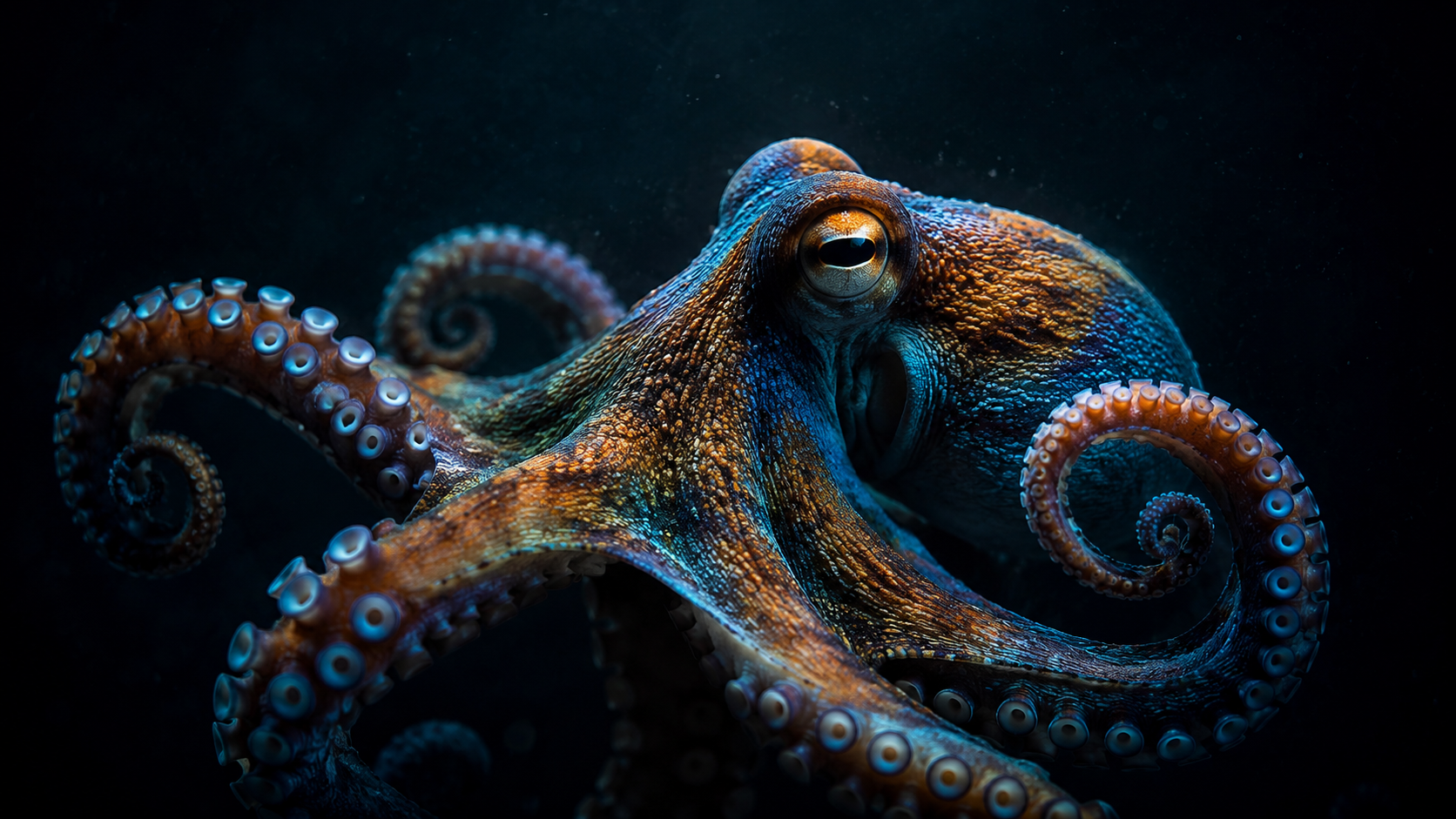
Key idea
Evolution does not design perfect organisms from scratch. It preserves traits that work under particular conditions, even when the result appears inefficient, extreme, or impossible.
Three.
That is how many hearts an octopus has.
But the number is only the beginning.
Those hearts belong to an animal with blue blood, eight flexible arms, and a nervous system that places most of its neurons outside its central brain.
Then there is the mantis shrimp.
It can analyse properties of light that human eyes cannot detect—and strike quickly enough to create cavitation in water.
A dehydrated tardigrade can reduce its biological activity to extraordinary levels and survive exposure to the space environment.
And one small jellyfish can reverse its development after reaching adulthood.
These animals are often described as aliens, biological mistakes, or proof that nature has no rules.
The facts behind those descriptions are real.
The simplified versions are usually less careful.
An octopus does not literally have nine separate brains.
A mantis shrimp does not simply see every colour better than we do.
A tardigrade is not indestructible.
And a biologically immortal jellyfish can still die.
The useful question is therefore not only:
“Is this strange animal fact true?”
It is:
“In what exact sense is it true?”
There are four rounds.
Choose an answer before reading each explanation.
Give yourself one point for every correct response.
Each round also includes one additional fact that did not appear in the video.
Round 1 — How many hearts does an octopus have?
Choose one:
- one
- two
- three
- four
The answer
An octopus has three hearts.
Two are known as branchial hearts.
They pump blood towards the gills, where it collects oxygen.
The third is the systemic heart.
It receives oxygenated blood from the gills and circulates it through the rest of the body.
This arrangement is unusual, but it is not random.
Octopuses have a closed circulatory system. Their blood remains inside vessels and must pass through the gills before reaching the muscles and organs.
The branchial hearts support circulation through the gills.
The systemic heart supports circulation through the rest of the animal.
The strange part appears when an octopus swims.
An octopus can move quickly by contracting the muscular wall of its mantle and forcing water through a funnel. This produces jet propulsion.
It also requires considerable effort.
During strong mantle contractions, the pulse generated by the systemic heart can become irregular or stop briefly.
That contributes to the high energetic cost of continuous swimming and helps explain why many octopuses spend more time crawling across the seafloor.
Three hearts do not make movement effortless.
They support a particular body operating under particular conditions.
Does an octopus really have nine brains?
No—not literally.
An octopus has one central brain and extensive neural networks throughout its eight arms.
Most of its neurons are located outside the central brain.
This allows the arms to handle some sensory processing and movement locally.
The central brain does not need to calculate every bend, twist, or sucker movement in real time.
It can send broader instructions while circuits inside the arms coordinate many of the details.
The phrase “nine brains” is a memorable way to describe decentralised control.
It becomes misleading when treated as an anatomical count.
The octopus does not have nine identical brains.
It has one central brain connected to eight limbs with unusually sophisticated local processing.
Why is octopus blood blue?
Human blood transports oxygen using haemoglobin.
Haemoglobin contains iron, producing the familiar red colour.
Octopus blood uses haemocyanin, an oxygen-carrying protein built around copper.
When oxygen binds to it, the blood appears blue.
This does not mean copper is universally better than iron.
The performance of an oxygen carrier depends on factors such as temperature, acidity, activity, and the physiology of the animal using it.
Many octopuses live in cold or oxygen-limited marine environments, and their haemocyanin functions within those conditions.
It is not the best solution in the abstract.
It is one workable solution inside a particular organism.
One extra fact — octopus suckers can taste by touching
The suckers on an octopus arm do more than grip.
They contain chemotactile receptors that respond to molecules on surfaces.
When an octopus explores a rock, shell, or possible food item, it gathers physical and chemical information at the same time.
A human hand can detect shape and texture.
An octopus sucker can combine touch with something closer to contact-based taste.
Hundreds of suckers are not simply holding the world.
They are sampling it.
Verdict
If you answered three, give yourself one point.
The next animal has far more photoreceptor classes than a human.
That does not produce the result you might expect.
Round 2 — Do more receptors mean better colour vision?
True or false:
An animal with more types of colour-sensitive photoreceptors must distinguish similar colours more accurately than a human.
The answer
False.
Mantis shrimp possess some of the most complex eyes known.
Depending on the species, the specialised midband across each eye can contain up to twelve spectral photoreceptor classes associated with colour, alongside additional systems for analysing polarised light.
Humans usually rely on three cone classes.
It seems reasonable to assume that twelve spectral channels would produce extraordinarily precise colour discrimination.
Laboratory experiments found something different.
When mantis shrimp were trained to distinguish between nearby wavelengths, they required a larger difference than humans normally do.
They possessed more spectral receptor classes but performed worse at separating similar colours.
That does not mean their visual system failed.
It means it is solving a different problem.
Human colour perception depends heavily on the brain comparing overlapping signals from three cone types.
Mantis shrimp appear to use a more direct system, with different channels responding to narrower regions of the spectrum.
This may allow rapid classification without the same level of neural comparison.
Humans extract subtle differences from fewer receptor classes.
Mantis shrimp may recognise useful categories quickly through a larger set of specialised channels.
More hardware does not automatically produce finer resolution.
The light humans cannot see
Colour is only one part of the mantis shrimp’s visual world.
Light waves can oscillate in different orientations.
This property is called polarisation.
Humans do not consciously perceive it without specialised equipment.
Many mantis shrimp can detect linear polarisation.
Some species can also analyse circularly polarised light, in which the orientation of the wave rotates as it travels.
Structures inside their eyes act similarly to biological quarter-wave plates. They transform circular polarisation into signals the underlying receptors can detect.
This ability has not been documented in any other known animal group.
It may help with communication, contrast detection, recognising objects, or identifying other mantis shrimp in visually complex underwater environments.
The mantis shrimp does not simply see a more colourful version of our world.
It receives categories of information our eyes leave out.
The second impact
Some mantis shrimp are known as smashers.
Their striking limbs use a spring-and-latch mechanism.
Muscles slowly load elastic structures within the appendage.
The latch releases.
Stored energy drives the club forwards much faster than direct muscle contraction could achieve alone.
Some strikes approach twenty-three metres per second.
The rapid movement lowers pressure in the surrounding water enough to produce cavitation.
A vapour bubble forms.
Then it collapses.
The target experiences the physical strike followed by the effects of the collapsing bubble.
That combination allows a relatively small animal to crack shells and damage hard materials.
The common comparison with a bullet is not especially useful.
Bullets and biological clubs differ in mass, energy, shape, and impact conditions.
The genuinely extraordinary fact is more precise:
the limb accelerates quickly enough to change the physical state of the surrounding water.
One extra fact — its eyes can roll
Mantis shrimp eyes do not only move up, down, left, and right.
They can also rotate around their viewing axis.
That rolling movement changes the orientation of polarisation-sensitive receptors relative to incoming light.
Movement is therefore part of how the eye analyses the scene.
The animal does not passively receive one fixed image.
It actively repositions its sensors to extract different information.
More receptors.
Moving detectors.
An optical system that does not behave like ours.
Core expected a shrimp.
The specifications disagree.
Verdict
If you answered false, add one point.
The next animal does not survive by becoming faster, stronger, or more perceptive.
It survives by nearly stopping.
Round 3 — What was more dangerous than the vacuum of space?
In a 2007 space-exposure experiment, which condition caused the greater reduction in tardigrade survival?
- vacuum
- unfiltered ultraviolet radiation
- microgravity
The answer
Unfiltered ultraviolet radiation.
During the Foton-M3 mission, dehydrated tardigrades spent twelve days in low Earth orbit.
Some groups were exposed to vacuum and cosmic radiation.
Other groups were also exposed to direct solar ultraviolet radiation.
A proportion of the animals exposed primarily to vacuum survived, rehydrated after returning to Earth, and resumed activity.
Survival fell sharply among groups exposed to intense ultraviolet light.
The result feels backwards.
Vacuum sounds like the obvious threat.
But the tardigrades were already dehydrated before exposure.
They were not walking, feeding, or living normally outside the spacecraft.
They survived by entering a resistant biological state before encountering those conditions.
Cryptobiosis
Active tardigrades depend on thin films of water.
When their environment dries, some species can enter anhydrobiosis, a form of cryptobiosis associated with extreme dehydration.
The animal contracts into a compact shape called a tun.
It loses almost all its body water.
Its measurable metabolic activity falls to extremely low levels.
Without normal amounts of liquid water, many biochemical reactions slow dramatically.
Protective molecules help stabilise membranes, proteins, and other cellular structures.
When water returns, the tardigrade may rehydrate and resume activity.
This ability did not evolve as preparation for space travel.
Tardigrades evolved in environments where the water surrounding them can disappear.
Survival in vacuum is a side effect of adaptations that help them endure dehydration on Earth.
That distinction matters.
An adaptation can prove useful under a condition the species never encountered during its evolutionary history.
“Tardigrades survive space” needs conditions
Not every tardigrade has the same tolerance.
The group contains many species with different capabilities.
Survival depends on factors including:
- species
- hydration state
- temperature
- exposure duration
- radiation dose
- preparation before exposure
A dehydrated tardigrade surviving twelve days does not mean an active tardigrade can live indefinitely in space.
The short headline is memorable:
“Tardigrades survive space.”
The useful version includes the conditions:
“Some dehydrated tardigrades survived twelve days exposed to parts of the low-Earth-orbit environment, while direct solar ultraviolet radiation greatly reduced survival.”
The second sentence is less magical.
It also tells you what happened.
One extra fact — Dsup protected cultured human cells
Researchers studying the tardigrade Ramazzottius varieornatus identified a protein called Dsup, short for damage suppressor.
The protein associates with DNA and chromatin.
When researchers engineered cultured human cells to produce Dsup, those cells showed less X-ray-induced DNA damage than cells without it.
This does not mean scientists created radiation-proof humans.
It was a cell-culture experiment involving one protein from one tardigrade species.
The cells did not become indestructible, and the result cannot be transferred directly to an entire human body.
That limitation matters precisely because this is the kind of finding that can quickly become exaggerated.
The real result remains significant:
a protein from an extremotolerant animal reduced radiation-related damage in cultured cells from another species.
Studying strange biology can reveal molecular tools with potential applications far beyond the original organism.
Verdict
If you answered ultraviolet radiation, add one point.
The tardigrade survives by suspending activity.
The final animal changes the direction of its development.
Round 4 — What does “biologically immortal” mean?
Which statement accurately describes Turritopsis dohrnii?
- it cannot be killed
- it remains an adult forever
- it can reverse from the adult medusa stage towards the polyp stage
- it creates a copy and transfers itself into it
The answer
It can reverse from the adult medusa stage towards the polyp stage.
Turritopsis dohrnii is a small hydrozoan commonly called the immortal jellyfish.
Its life cycle includes several distinct forms.
A polyp remains attached to a surface.
It can produce free-swimming medusae—the form most people recognise as jellyfish.
Those medusae can mature and reproduce sexually.
Development normally moves forwards through this sequence.
Under stress, injury, starvation, or ageing, Turritopsis can follow a different route.
The adult medusa contracts and loses its normal shape.
Its tissues reorganise into a cyst-like stage attached to a surface.
That stage can then produce polyps again.
A sexually mature, free-swimming form has returned towards an earlier, attached phase of its life cycle.
That reversal is the source of the immortality claim.
Transdifferentiation
Specialised cells normally perform particular jobs.
A muscle cell behaves like a muscle cell.
A nerve cell behaves like a nerve cell.
During reverse development, some cells can change identity through a process called transdifferentiation.
Cells that already had specialised roles become involved in building different tissues.
The process includes extensive changes in gene activity, cell identity, and body organisation.
Calling this “turning back into a baby” is easy to understand.
It is not biologically exact.
A polyp is not simply an infant version of an adult medusa.
It is a different stage with a different body plan, lifestyle, and method of reproduction.
The jellyfish is not reversing time.
Its tissues are activating an alternative developmental pathway.
Is it really immortal?
Only in a narrow, conditional sense.
The organism may escape death from ageing by reversing its life cycle.
It can still be:
- eaten
- infected
- physically destroyed
- killed by unsuitable environmental conditions
- damaged beyond its ability to reorganise
There is no evidence that an individual jellyfish has survived since the age of the dinosaurs.
The life-cycle reversal may be repeatable.
That does not prove that one animal has lived indefinitely.
“Immortal jellyfish” is a useful phrase when it opens the explanation.
It becomes misleading when it replaces the explanation.
One extra fact — it can reset more than once
Repeated life-cycle reversal has been observed under laboratory conditions.
The process is not limited to one unique accident.
Individuals derived from the same genetic line have completed reverse development on multiple occasions.
This makes Turritopsis dohrnii valuable for studying:
- cell identity
- developmental plasticity
- tissue reorganisation
- DNA maintenance
- regeneration
- ageing
The research does not reveal a hidden human immortality switch.
Humans do not possess a dormant polyp stage waiting to be activated.
The jellyfish may help researchers understand principles of cellular reprogramming.
That is already enough.
Core has closed the human upgrade menu.
Verdict
If you chose life-cycle reversal, add your final point.
Your results
0 points — A useful starting point
The viral versions probably sounded more familiar than the mechanisms beneath them.
That is not a failure.
Claims such as “nine brains”, “indestructible”, and “immortal” are memorable precisely because they remove the conditions.
You now have four better questions to ask the next time an animal fact sounds impossible.
1 point — System online
You separated at least one biological mechanism from its popular headline.
Core has restored partial access.
2 points — Strong
You recognised that extraordinary abilities usually depend on particular structures or conditions.
Solid result.
3 points — Suspiciously informed
You distinguished distributed neural control, specialised vision, cryptobiosis, and reverse development.
Core is impressed.
Core is also checking whether another tab was open.
4 points — Biological systems auditor
You found all four intended answers.
Either you understand the difference between a striking headline and a precise claim…
or you read ahead.
Only one receives official approval.
What the four corrections reveal
This challenge is not a validated intelligence test.
It does not measure your overall knowledge of zoology.
It tests something narrower:
whether you can separate an extraordinary claim from the mechanism and conditions beneath it.
Each round followed the same pattern.
- “The octopus has nine brains” is memorable. “It has one central brain and extensive neural processing distributed through its arms” is useful.
- “The mantis shrimp sees more colours than humans” is memorable. “It has more spectral channels but poorer discrimination between nearby wavelengths” is useful.
- “Tardigrades survive space” is memorable. “Some dehydrated tardigrades survived a limited orbital exposure, while ultraviolet radiation greatly reduced survival” is useful.
- “The immortal jellyfish cannot die” is memorable. “It can reverse development but remains vulnerable to predators, disease, and irreversible damage” is useful.
The first statement attracts attention.
The second explains reality.
Scientific honesty does not require removing every dramatic phrase.
It requires eventually restoring what the dramatic phrase left out.
How impossible animal facts become exaggerated—and how to check them
A research result usually passes through several layers before reaching a caption, thumbnail, or conversation.
At each layer, one kind of detail tends to disappear.
1. A metaphor becomes literal
The phrase “nine brains” describes a distributed nervous system.
Repeated often enough, it starts sounding like a literal anatomical count.
Check: Ask whether the key term is technical or metaphorical.
2. A maximum becomes normal
A brief experimental survival under an extreme condition becomes something every animal in the group can tolerate indefinitely.
Check: Look for the exposure duration and biological state of the animal.
3. One species becomes the entire group
A trait measured in one tardigrade or mantis shrimp species becomes a claim about all tardigrades or all mantis shrimp.
Check: Identify the species used in the research.
4. A narrow result becomes an absolute claim
“Can reverse one part of the ageing process” becomes “cannot die”.
“Reduced X-ray damage in cultured cells” becomes “makes humans radiation-proof”.
Check: Write down exactly what researchers measured.
5. A comparison mixes different variables
A fast biological strike becomes “the force of a bullet”.
More receptor classes become “more colours than humans can imagine”.
Speed, force, energy, accuracy, and perception are not interchangeable.
Check: Confirm that both sides of the comparison use the same measurement.
Fact-check an impossible animal claim
Do this right now
- 1Remove dramatic adjectives and write the claim in plain language.
- 2Identify the exact species and biological state involved.
- 3Find the exposure time, experimental conditions, and measured outcome.
- 4Separate what researchers observed from what later headlines inferred.
- 5Rewrite the claim with one mechanism and one limitation.
Try it with the tardigrade
Start with the viral version:
“Tardigrades are indestructible.”
Remove the absolute claim:
“Some tardigrades survive extreme conditions.”
Add the biological state:
“Some dehydrated tardigrades survive certain extreme conditions.”
Add one measured example:
“Some dehydrated tardigrades survived twelve days exposed to parts of the low-Earth-orbit environment.”
Add the limitation:
“Direct solar ultraviolet radiation greatly reduced survival, and the animals were not active during exposure.”
The final version is longer.
It is also testable, understandable, and difficult to misinterpret.
Use the same process with another claim:
- an octopus has nine brains
- a mantis shrimp sees more colours than a human
- tardigrades cannot die
- immortal jellyfish live forever
Share your corrected version in the comments on the YouTube video.
Core accepts precision.
Reluctantly.
Sources and further reading
Octopus circulation, neural organisation, and chemotactile sensing
- Wells, M. J., O’Dor, R. K., Mangold, K., and Wells, J. (1987). “Blood Flow and Pressure Changes in Exercising Octopuses.” Journal of Experimental Biology, 131, 175–187.
- Wells, M. J. (1980). “Nervous Control of the Heartbeat in Octopus.” Journal of Experimental Biology, 85, 111–128.
- Sumbre, G. et al. (2001). “Control of Octopus Arm Extension by a Peripheral Motor Program.” Science, 293, 1845–1848.
- van Giesen, L. et al. (2020). “Molecular Basis of Chemotactile Sensation in Octopus.” Cell, 183.
- Oellermann, M. et al. (2015). “Blue Blood on Ice: Modulated Blood Oxygen Transport Facilitates Cold Compensation and Eurythermy in an Antarctic Octopod.” Frontiers in Zoology, 12.
Mantis shrimp vision and striking mechanics
- Thoen, H. H. et al. (2014). “A Different Form of Color Vision in Mantis Shrimp.” Science, 343, 411–413.
- Kleinlogel, S. and White, A. G. (2008). “The Secret World of Shrimps: Polarisation Vision at Its Best.” PLOS ONE, 3.
- Patek, S. N. et al. (2004). “Deadly Strike Mechanism of a Mantis Shrimp.” Nature, 428, 819–820.
- Daly, I. M. et al. (2016). “Dynamic Polarization Vision in Mantis Shrimps.” Nature Communications, 7.
Tardigrade cryptobiosis, space exposure, and Dsup
- Jönsson, K. I. et al. (2008). “Tardigrades Survive Exposure to Space in Low Earth Orbit.” Current Biology, 18, R729–R731.
- Hashimoto, T. et al. (2016). “Extremotolerant Tardigrade Genome and Improved Radiotolerance of Human Cultured Cells by Tardigrade-Unique Protein.” Nature Communications, 7, 12808.
- European Space Agency. (2008). “Tiny Animals Survive Exposure to Space.”
Reverse development in Turritopsis
- Piraino, S. et al. (1996). “Reversing the Life Cycle: Medusae Transforming into Polyps and Cell Transdifferentiation in Turritopsis.” The Biological Bulletin, 190, 302–312.
- Matsumoto, Y. et al. (2019). “Transcriptome Characterization of Reverse Development in Turritopsis dohrnii.” G3: Genes, Genomes, Genetics, 9, 4127–4138.
- Hasegawa, Y. et al. (2022). “Genome Assembly and Transcriptomic Analyses of the Repeatedly Rejuvenating Jellyfish Turritopsis dohrnii.” DNA Research.
Quick Questions
How many hearts does an octopus have?
An octopus has three hearts. Two branchial hearts pump blood towards the gills, while the systemic heart circulates oxygenated blood through the rest of the body.
Does an octopus really have nine brains?
No. It has one central brain and extensive neural networks distributed throughout its eight arms. The phrase 'nine brains' is a metaphor for decentralised control, not a literal anatomical count.
Why is octopus blood blue?
Octopus blood uses haemocyanin, a copper-containing protein, to transport oxygen. When oxygenated, haemocyanin gives the blood a blue appearance.
Four animals, four different solutions
The octopus does not prove that three hearts are universally better than one.
Its circulation divides work between the gills and the rest of a cephalopod body.
The mantis shrimp does not prove that more photoreceptors create perfect colour vision.
Its eyes prioritise specialised information and a different form of processing.
The tardigrade does not prove that an animal can live anywhere.
It shows how adaptations for dehydration can preserve viability through conditions far beyond its ordinary habitat.
The immortal jellyfish does not prove that death has been defeated.
It shows that adult development is not irreversible in every species.
These animals look like systems no single engineer would have designed from a blank page.
That is because evolution does not begin with a blank page.
Every new variation appears inside an organism that already has a body, a history, and inherited limitations.
Natural selection does not search every possible design and choose the cleanest one.
It filters the variations that exist.
A trait does not need to be perfect.
It does not need to work in every environment.
It only needs to contribute enough to survival and reproduction under the conditions experienced by that population.
That is why biological advantages often arrive with trade-offs.
Jet propulsion gives an octopus speed but requires considerable energy.
A mantis shrimp gains rapid, specialised visual classification without exceptional discrimination between nearby colours.
Cryptobiosis allows a tardigrade to wait through dehydration, but not to feed or reproduce while suspended.
Reverse development may help a jellyfish escape senescence, but it offers no guarantee against a predator.
The result is not perfect design.
It is workable history.
Four animals.
Four systems.
Four different ways of remaining alive.
Now decide which one is the most extraordinary:
- the octopus and its distributed body
- the mantis shrimp and its unfamiliar visual world
- the tardigrade and its suspended biology
- the jellyfish and its reversible development
Share your answer in the comments on YouTube.
And bring evidence.
Core is still reviewing the documentation.
If you want to keep exploring, continue reading on AtomicCurious.
And if you want the next challenge before everyone else, join the newsletter.
⚛️ AtomicCurious — Exploring science, technology & smart curiosities.
Watch video
Video
Keep exploring
More from Quiz · Core
More posts in this format — then jump across routes whenever you want.
The WTF Chain: How a Pink Flamingo Is Connected to Your Next Breath
Flamingos aren’t born pink. Shrimp aren’t either. And that chain ends with the oxygen you breathe.
Your Brain vs Reality: Can You Read "PARIS IN THE THE SPRING" Without Failing?
Your brain does not see reality exactly the way you think. It constantly fills in, skips and reconstructs information.
What Do These Images Have in Common? The Test That Reveals How Your Brain Connects Patterns
Your brain detects relationships even before you are consciously aware of them. This quiz puts that system to the test.
Real Image or AI-Generated?
AI-generated images are crossing the point where most people stop noticing the difference.
AtomicCurious · Core
Now turn it into action
The idea doesn’t end here. You can keep exploring it on YouTube or take it further in the newsletter.
Resources
Recommended resources
Book
The Soul of an Octopus
An engaging journey into octopus intelligence, personality, and the surprising connections these animals can form with humans.
Get the book →
Free App
Seek by iNaturalist
A free app that uses your camera to identify wildlife, plants, and fungi while turning real-world exploration into challenges and badges.
Start exploring →
Book
An Immense World
An accessible exploration of how animals experience light, sound, smell, movement, and parts of reality that human senses cannot detect.
Get the book →
Some links are affiliate links. We may earn a commission at no extra cost to you.