What Do These Images Have in Common? The Test That Reveals How Your Brain Connects Patterns
Your brain detects relationships even before you are consciously aware of them. This quiz puts that system to the test.
Key idea
Finding connections is not only about knowing more facts. It is about changing what you look for: shape, change, structure, behavior, function, or meaning.
Three images.
One hidden connection.
That is the entire challenge.
It sounds simple.
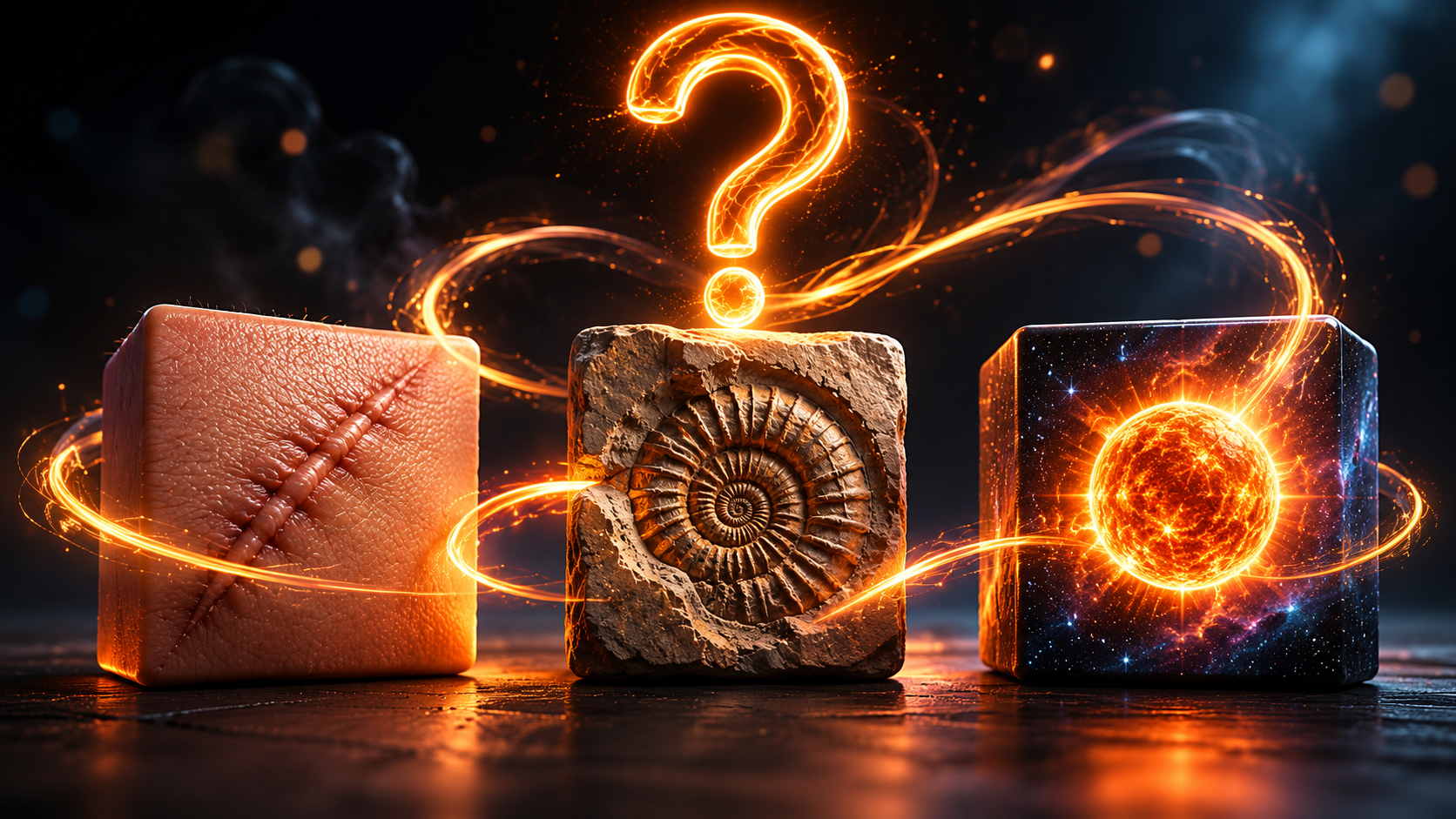
Until the images are a scar, a fossil, and a star.
At first, your brain notices the differences.
One belongs to your body.
One comes from ancient life.
One shines in space.
Different materials.
Different sizes.
Different worlds.
But association challenges ask you to stop looking at what separates things and search for the rule that connects them.
Sometimes the connection is physical.
Sometimes it is based on what the objects do.
Sometimes it is hiding beneath the surface.
And sometimes the answer changes the way you see all three.
That is what this challenge is designed to test.
Not your intelligence.
Not how many facts you memorized.
How quickly you can change the question your brain is asking.
“What if I am looking for the wrong kind of connection?”
Keep track of your score.
There are six rounds.
One point for each correct connection.
You do not need to use the exact same words used in the answer.
If you found the same underlying idea, the point counts.
Before we begin — one warm-up
Look at these three things:
- a kettle
- an old steam locomotive
- a geyser
What do they have in common?
Take five seconds before reading further.
The answer is simple:
they all release steam.
A kettle releases steam when water boils.
A steam locomotive uses heated water to produce steam.
A geyser releases hot water and steam from below the ground.
That was the warm-up.
It showed you the basic rule of the game:
the three things do not need to belong to the same category.
They only need to share one clear connection.
The warm-up does not count toward your score.
Your six possible points start now.
Round 1 — Look at the shape
Here are your first three objects:
- a comb
- a zipper
- a saw
What do they have in common?
Do not search for where they are used.
Do not search for what they are made of.
Just look.
The connection
They all have teeth.
A comb has a row of teeth that separates and arranges hair.
A zipper has two rows of teeth that interlock when the slider passes over them.
A saw uses sharpened teeth to cut through material.
The word is the same.
The purpose is completely different.
This is the easiest type of association because the shared feature is visible.
Once someone points it out, it feels obvious.
Before the answer, however, your brain may place each object into a separate category:
- personal care
- clothing
- tools
The connection appears only when you ignore those categories and focus on one shared detail.
The saw’s teeth are simply the least friendly version.
Verdict
If you answered “teeth,” give yourself one point.
The first round required observation.
The next one requires you to imagine the objects being used.
Round 2 — Imagine using them
Look at these three:
- a candle
- a pencil
- a bar of soap
What do they have in common?
Their shapes are different.
Their purposes are different.
Think about what happens over time.
The connection
They all become smaller as you use them.
A candle burns down while it remains lit.
A pencil becomes shorter as you write, sharpen it, and continue using it.
A bar of soap slowly wears away each time it comes into contact with water and your hands.
All three are useful partly because they are gradually consumed.
The object changes as it performs its job.
That is the hidden connection.
This round is slightly harder because a still image does not show the answer.
You have to imagine a process.
You have to see the object now and predict what it will look like later.
Eventually, the soap becomes so small that it spends more time slipping out of your hands than actually cleaning them.
Verdict
If you answered that they shrink, wear down, or are consumed during use, add one point.
So far, you have searched for:
- a visible feature
- a change over time
For the next round, the answer is beneath the surface.
Round 3 — Look inside
Your next three images are:
- the cross-section of a tree trunk
- an onion cut in half
- the inside of the Earth
What do they have in common?
The difference in scale is enormous.
One fits inside your hand.
One can grow for decades or centuries.
One is an entire planet.
Ignore the size.
Look at the internal structure.
The connection
They are all organized in layers.
A tree trunk develops visible growth rings as new wood forms around earlier growth.
An onion is composed of overlapping layers wrapped around its center.
The Earth is also divided into major internal layers, including the crust, mantle, outer core, and inner core.
These structures are not identical.
They form in very different ways.
But visually, they share the same basic arrangement:
one region surrounding another.
The outside does not reveal the full pattern.
You have to cut through the object, or imagine seeing inside it, before the connection becomes clear.
A tree.
An onion.
A planet.
Same broad structural idea.
Very different consequences if you try to cut them open.
And yes, the onion is the only one that could actually make you cry.
Verdict
If you answered “layers,” add one point.
You have now used shape, change, and internal structure.
The next round is not about what the objects contain.
It is about what they send back.
Round 4 — Think about their behavior
Consider these three:
- a mirror
- an echo
- a boomerang
What do they have in common?
One is an object.
One is a sound phenomenon.
One is something you throw.
The connection is not what they look like.
It is the pattern of what happens.
The connection
They all send something back.
A mirror reflects light toward your eyes, allowing you to see an image.
An echo occurs when sound travels outward, reflects from a surface, and returns to the listener.
A returning boomerang follows a curved flight path that can bring it back toward the person who threw it.
Light goes out and returns.
Sound goes out and returns.
The boomerang goes out and, when thrown correctly, returns.
The shared pattern is movement away from a starting point followed by movement back toward it.
This is a different kind of association.
The three examples do not share the same material, appearance, or scale.
They share a sequence.
Something leaves.
Something happens.
Something comes back.
Verdict
If your answer involved returning, reflecting, bouncing back, or sending something back, add one point.
Now things get harder.
The next connection appears across three completely different kinds of relationship.
Round 5 — Change the scale
Here are the next three:
- a bridge
- a needle and thread
- a handshake
What do they have in common?
A bridge can stretch across miles.
A needle works across inches.
A handshake takes place between two people.
The answer is not hidden in their appearance.
Look at what each one makes possible.
The connection
They bring two separate sides together.
A bridge connects places divided by a river, valley, road, or other obstacle.
A needle and thread join separate pieces of fabric.
A handshake creates a direct connection between two people and can represent greeting, trust, agreement, or cooperation.
One joins locations.
One joins material.
One joins people.
The scale changes.
The type of connection changes.
The underlying function remains.
They reduce separation.
They create a link where there was previously a gap.
And the handshake usually lasts only a moment, although some people still manage to make it strangely uncomfortable.
Verdict
If you answered that they connect, join, or bring two sides together, add one point.
Five rounds complete.
The final connection is not based on shape.
It is not based on movement.
It is not based on function.
It is based on an idea.
Round 6 — Find the idea
Final round:
- a scar
- a fossil
- a star in the night sky
What do they have in common?
Take your time.
A physical description will not be enough.
Think about what each one allows you to see.
The connection
They all let us see the past in the present.
A scar is a visible result of something that happened to your body.
The original wound may be closed.
The pain may be gone.
But the event left a mark.
A fossil preserves physical remains, impressions, or traces of organisms that lived long before us.
The organism is gone.
Part of its history remains visible.
And when you look at a star, you do not see it exactly as it is at this instant.
Light takes time to travel.
The light entering your eyes began its journey in the past.
For nearby stars, that journey takes years.
For more distant objects, it can take centuries, thousands of years, or far longer.
You are not receiving the star’s present moment.
You are receiving information that has finally arrived.
A scar.
A fossil.
A star.
Three different ways an earlier event can remain visible now.
The past does not always disappear.
Sometimes it leaves a mark.
Sometimes it leaves a shape.
And sometimes it leaves light traveling across the universe.
Verdict
If your answer involved the past, evidence, history, or something earlier remaining visible in the present, add your final point.
Your results
Now count your score.
0–1 points — Warming up
You may have focused on the most obvious differences between the images. That is normal. Your brain categorizes objects quickly because categories are useful: a saw is a tool, an onion is food, and a star is in space.
The challenge begins when you temporarily ignore those labels and search for another way to organize what you see.
2–3 points — Strong
You found several connections and were able to change the kind of pattern you were searching for. You probably spotted some visual relationships quickly, while the more abstract rounds required additional time or knowledge.
Solid result.
4–5 points — Slightly suspicious
You are good at moving between different types of association: shape, process, structure, behavior, function, and meaning.
Core is impressed.
Core is also reviewing the footage.
6 points — Impressive
You found every intended connection.
Either you are extremely good at association challenges…
or you scrolled down before answering.
Only one of those earns the point.
What this challenge actually tests
This is not a scientifically validated intelligence test. It does not diagnose creativity, and it does not prove that someone who scored six is smarter than someone who scored two.
What it reveals is something simpler: the answer you find depends partly on the question you ask and partly on the knowledge you already have.
Consider how the search changed across the rounds:
- In round one, you asked: “What visible part do they share?”
- In round two: “What happens when they are used?”
- In round three: “How are they organized inside?”
- In round four: “What pattern do they follow?”
- In round five: “What function do they perform?”
- In round six: “What larger idea connects them?”
The objects did not change. Your search strategy did.
But perspective is not the only factor. Some connections can be discovered through observation alone. Others require background knowledge. You cannot infer the final connection from the image of a star unless you know that light takes time to travel.
That does not weaken the challenge. It reveals that association uses two different resources:
- how flexibly you compare information
- what information you already know
The central skill is not forcing random connections or finding vague similarities that could apply to anything. It is finding one clear rule that explains all three examples.
The difference between a strong connection and a weak one
You can connect almost any three things if the rule is vague enough. A bridge, a banana, and the Moon all exist. A fossil, a pencil, and a shoe are all made of atoms. A star, a bar of soap, and a handshake could all fit inside something larger.
Those answers are technically true.
They are also useless.
A satisfying association has three qualities.
1. It is specific
“Everything exists” applies to almost everything. “They all become smaller while being used” applies clearly to the candle, pencil, and soap.
Specificity makes the connection meaningful.
2. It explains all three equally well
A weak answer fits one object perfectly and requires an elaborate excuse for the other two. A strong answer feels balanced. No object appears to have been added only to force the puzzle to work.
3. It creates an immediate “of course” moment
The best answer can be difficult to discover but easy to understand. Once revealed, it should not need a five-minute defense.
You should be able to look back at the images and see why the connection works.
That feeling is the reward.
Why your brain notices differences first
When you see a comb, a zipper, and a saw, your brain already knows what each object is for. That knowledge is useful. It helps you recognize objects quickly and act without analyzing every detail from the beginning.
But categories can also hide relationships.
Once your brain decides that one is a grooming object, one belongs to clothing, and one is a cutting tool, the three objects feel separate. The association appears when you temporarily loosen those categories and compare the objects in a new way.
This is one reason visual association challenges can feel impossible and obvious within seconds. Before the reveal, you are searching inside one mental frame. After the reveal, the frame changes.
The teeth were visible the entire time.
You simply were not comparing them.
Abstract rounds work differently. The star challenge does not depend only on seeing the image from another angle. It also depends on knowing something about light and distance.
Sometimes the answer is hidden by attention.
Sometimes it is hidden by missing knowledge.
Often, it is a combination of both.
Six ways to search for a hidden connection
When you face another association puzzle, do not stare at the images and hope the answer appears. Change the kind of question you ask.
1. Look for a shared part
Do they all have teeth, rings, branches, keys, wings, or another repeated feature?
2. Imagine them changing
Do they grow, shrink, melt, disappear, open, close, or transform in a similar way?
3. Look beneath the surface
Do they contain layers, chambers, networks, roots, or repeating structures?
4. Compare their behavior
Do they return, spread, rotate, reflect, attract, or respond in the same pattern?
5. Compare their function
Do they connect, protect, store, guide, unlock, separate, or translate something?
6. Search for a broader idea
Do they represent memory, time, trust, identity, risk, evidence, or another abstract concept?
You do not need to try all six approaches every time. Usually, changing the question once or twice is enough to reveal a new possibility.
And when changing the question is not enough, consider whether the puzzle depends on a fact you have not encountered yet.
Build your own connection challenge
Do this right now
- 1Choose one clear connection first, such as 'they all unlock something.'
- 2Find three examples from different categories, such as a key, a password, and a fingerprint.
- 3Check that the connection fits all three without extra explanation.
- 4Remove any image that makes the answer too obvious.
- 5Test the challenge on someone before sharing it.
Create your own round
Now it is your turn.
Choose three things that appear unrelated.
Then find one connection that explains all three.
Start with the answer before choosing the images.
For example:
Connection: they all unlock something.
Possible images:
- a physical key
- a password screen
- a fingerprint scanner
Or:
Connection: they can spread from one person to another.
Possible images:
- a yawn
- a smile
- panic in a crowd
The strongest challenges mix different categories while keeping the final answer simple.
A physical object.
A natural process.
A human action.
One clean rule.
That contrast makes the reveal satisfying.
Create your own set and share it in the comments on the YouTube video.
The strongest challenge may appear in a future Core test.
Quick Questions
Is this an intelligence test?
No. It is an association challenge, not a validated measure of intelligence. Your score can be affected by experience, attention, familiarity with the objects, background knowledge, and the kind of connection you search for first.
What if my answer was different but still worked?
Count it if your connection is clear, specific, and applies equally well to all three images. Some combinations can support more than one valid answer. The goal is not to guess one exact sentence. It is to find a strong shared rule.
Why do some answers seem obvious after the reveal?
In visual rounds, the shared feature may have been visible all along, but your attention was organized around a different category. The reveal changes what you compare. More abstract rounds can also depend on background knowledge. In those cases, the reveal does not merely redirect your attention—it gives you a fact or idea you may not have known.
So, what do they have in common?
The answer depends on where you look.
Sometimes it is in the shape.
Sometimes it appears only when the object changes.
Sometimes it is hidden inside.
Sometimes it is a behavior.
Sometimes it is a function.
And sometimes the connection is an idea large enough to unite a scar, a fossil, and a star.
That is what makes these challenges useful. They remind you that the first difference you notice is not the only way to organize what you see.
The world stays the same.
The objects stay the same.
The relationship appears when you change your perspective—or when you learn the missing fact that makes the relationship visible.
Now create your own set of three.
Make the connection clear.
Make it surprising.
Then share it in the comments on YouTube.
And make Core work for the answer.
If you want to keep exploring, you can keep reading on AtomicCurious.
And if you want the next challenges before everyone else, join the newsletter.
⚛️ AtomicCurious — Exploring science, technology & smart curiosities.
Watch video
Video
Keep exploring
More from Quiz · Core
More posts in this format — then jump across routes whenever you want.
The WTF Chain: How a Pink Flamingo Is Connected to Your Next Breath
Flamingos aren’t born pink. Shrimp aren’t either. And that chain ends with the oxygen you breathe.
Your Brain vs Reality: Can You Read "PARIS IN THE THE SPRING" Without Failing?
Your brain does not see reality exactly the way you think. It constantly fills in, skips and reconstructs information.
Real Image or AI-Generated?
AI-generated images are crossing the point where most people stop noticing the difference.
How Many Hearts Does an Octopus Have?
Octopuses feel alien for a reason: much of their biology breaks human intuition.
AtomicCurious · Core
Now turn it into action
The idea doesn’t end here. You can keep exploring it on YouTube or take it further in the newsletter.
Resources
Recommended resources
Book
Lateral Thinking
A classic guide to breaking habitual patterns, changing perspective and finding alternatives that conventional thinking often miss.
Read the book →
Book
A Whack on the Side of the Head
An accessible and entertaining guide filled with exercises, puzzles and examples designed to break through creative blocks and encourage new ways of thinking.
Read the book →
Free Tool
PuzzGrid
A free tool for solving and creating connection puzzles, ideal for practising the same kind of pattern recognition and lateral thinking explored in this post.
Try PuzzGrid →
Some links are affiliate links. We may earn a commission at no extra cost to you.